



Financial sanctions are essential government tools for achieving foreign policy objectives – and compliance is mandatory – but the sanctions landscape can be complex to navigate.
Here we unpack some key questions around this important topic.
- Understand financial sanctions and why they matter.
- Uncover best-practice approaches for remaining compliant as well as the consequences for non-compliance.
Financial sanctions enforce economic and trade bans against foreign jurisdictions and regimes, as well as individuals and entities engaging in harmful activity.
In the United States, the Office of Foreign Assets Control (OFAC) is responsible for implementing and enforcing financial sanctions, but the sanctions landscape is global in nature.
Specific sanctions have been outlined by the EU, the UN and many other governments, including Canada, Australia, the UK, and many more.
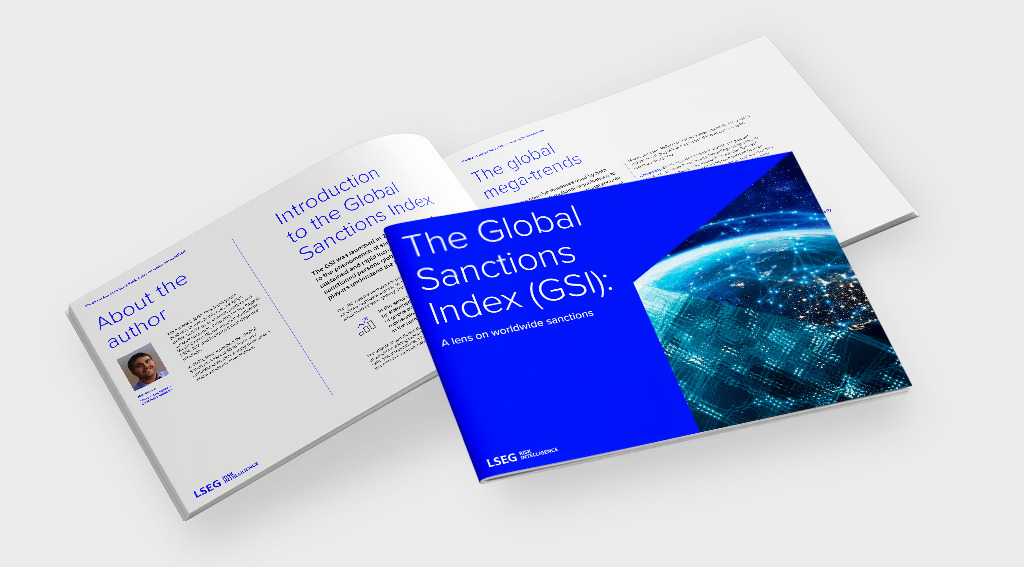
The 5th edition of the Global Sanctions Index (GSI) report by LSEG Risk Intelligence provides a detailed account of the key changes in global sanctions over the past year, as well as insights into the most important mega-trends – including uncertainty – that will shape sanctions in the coming months.
Here we answer some key questions around financial sanctions.
Five key questions answered
1. What are financial sanctions?
Financial sanctions are measures taken against targeted jurisdictions and regimes (including individuals and entities) engaging in harmful activities.
They are designed to restrict or prohibit transactions and can include entire countries or geographic regions.
They are primarily used to exert pressure to change negative behaviour, such as involvement in terrorism, money laundering, human rights abuses, the spread of weapons, and more.
These sanctions can be effective tools for achieving foreign policy objectives and guiding a nation’s interactions with other countries.
Some examples of common types of sanctions include:
• Asset freezes, including blocking access to the bank accounts, property or investments of a sanctioned individual or entity.
• Trade embargoes, such as bans on imports and exports to or from a sanctioned country.
• Investment bans, which can restrict or prohibit investments in sanctioned countries.
• Financial aid restrictions, which can prevent access to financial assistance, including loans, grants and aid programmes.
2. Why do financial sanctions matter?
Financial sanctions matter because they have economic and geopolitical repercussions and can therefore significantly impact global stability.
Sanctions can have:
• Economic consequences, for example governments can prohibit transactions with entire countries or geographic regions.
• Geopolitical implications, for example trade-related delays because of sanctions can create tension between countries and/or entities across the globe.
3. What are some of the consequences of non-compliance?
Non-compliance with global sanctions can have serious consequences, including:
• Potentially severe reputational damage: The impact of reputational damage is often unquantifiable – it can lead to long-term lack of credibility, tarnished customer relationships, and a loss of trust in your brand.
• Operational disruptions: If you are subject to an investigation, this can substantially disrupt day-to-day operations, with knock-on effects for your organisation.
• Criminal charges: In many cases, failure to comply with financial sanctions can result in criminal charges and even imprisonment.
4. What are the biggest challenges in sanctions compliance?
Implicit or narrative sanctions are often the biggest challenge in sanctions compliance.
Entities or individuals may not be explicitly named, but may be covered by broad narrative sanctions or be sanctioned based on their connections to a sanctioned entity or individual.
Some other key challenges include, but are not limited to:
• Complexity: The sheer volume and complexity of sanctions can be overwhelming, and often specialist knowledge is needed to navigate requirements.
• Inaccurate data: Inaccurate or incomplete data can leave you vulnerable to inadvertently transacting with a sanctioned entity or individual.
• High false positive rates: In some instances, robust screening can lead to false positive rates, disrupting legitimate relationships.
5. How can I improve my compliance?
The sanctions landscape is dynamic and complex, but there are resources and solutions that can cut through this complexity and help you keep abreast of ongoing changes.
The OFAC Framework for Compliance Commitments provides useful guidelines around sanctions compliance, and all organisations subject to US jurisdiction and foreign entities doing business with the US should review this.
It also is essential to implement a robust sanctions screening programme that starts with reliable access to accurate data, deep insights and comprehensive reports.
Sanctions are constantly updated, so timely data is essential to keep you informed of changes as they happen.
Some key points to remember include:
• Screening – of both customers and transactions – is an important first step in ensuring that you do not transact with any sanctioned individual or entity.
• Where heightened potential risk is identified, further investigations in the form of enhanced due diligence (EDD) can help you understand more about potential risk. Effective EDD delivers detailed insights and background checks.
• Ongoing transaction monitoring is also essential, because new risks can emerge at any time. Robust monitoring helps you uncover potential links to sanctioned individuals or entities.
The key take-away is this: complying with financial sanctions is non-negotiable, but with the right data, tools and expertise, you can cut through complexity, boost your efficiency and streamline your compliance function.
Download the latest Global Sanctions Index (GSI) report for more insights.
Featured image: Edited by Fintech News Singapore, based on image by thanyakij-12 via Freepik
