90% of Large Firms Connect AI Tools to Internal Systems, SFC AI Readiness Survey Finds
The survey spotlighted the extensive use of AI across business and control functions, as well as the challenges that came with scaling its use responsibly.
The survey spotlighted the extensive use of AI across business and control functions, as well as the challenges that came with scaling its use responsibly. It covered 20 large financial firms with 78 affiliated licensed corporations in Hong Kong.
The responses suggest AI use is widening across business and control functions, with closer integration into internal systems and, in some applications, greater autonomy.
90% of Surveyed Firms Connect AI to Internal Systems
The responses indicate that AI is increasingly being built into firms’ internal systems rather than used only as a standalone tool. It is most often connected to messaging platforms and knowledge repositories, which suggests that firms use it to find and use their institutional information.
AI is also linked to customer data, compliance platforms, and trading-related systems, extending into business and operational workflows.
The SFC shared that it points to an expanded role for AI as an interface between staff, information, and trading systems, as the survey noted. However, being connected to a system is not the same as having permission to change records or carry out transactions.
55% of Firms Have Taken Agentic AI Into Production or Pilots
Agentic AI is starting to take hold among the surveyed firms, though they are at very different stages. Six firms allow agentic AI in live production, and another five allow it in controlled pilots or tests.
Together, these 11 firms make up 55% of respondents. The other nine are still developing or considering agentic AI use cases.
The survey also asked which actions these systems can perform on their own. The options ranged from low-risk tasks, such as retrieving information and generating content, to higher-impact ones, such as modifying records, initiating transactions, and approving decisions without human intervention.
From the responses, the survey highlighted eight examples that respondents flagged as agentic or as involving partly or fully automated decision-making.
These comprise research search and question answering, cybersecurity operations, enhanced due-diligence assistance, software-development support, algorithmic execution and hedging, request for quotation processing, margin-call and collateral processing, and client onboarding and KYC document processing,
According to the SFC and its survey, the examples show that there is no single required model for combining agentic AI with human involvement. Human oversight does not have to mean manually approving every output or action.
What matters is who sets the system’s objectives and authority, how its activity is monitored, and when and how people can step in. The level of oversight should match the application’s potential impact.
SFC Puts Human Accountability at the Centre of AI Oversight
As AI becomes more embedded in firms’ systems and takes on more autonomous tasks, the SFC’s supervisory focus is organising its efforts towards how firms manage their risks and remain accountable for their actions, the Large Firm AI Readiness Survey indicated.
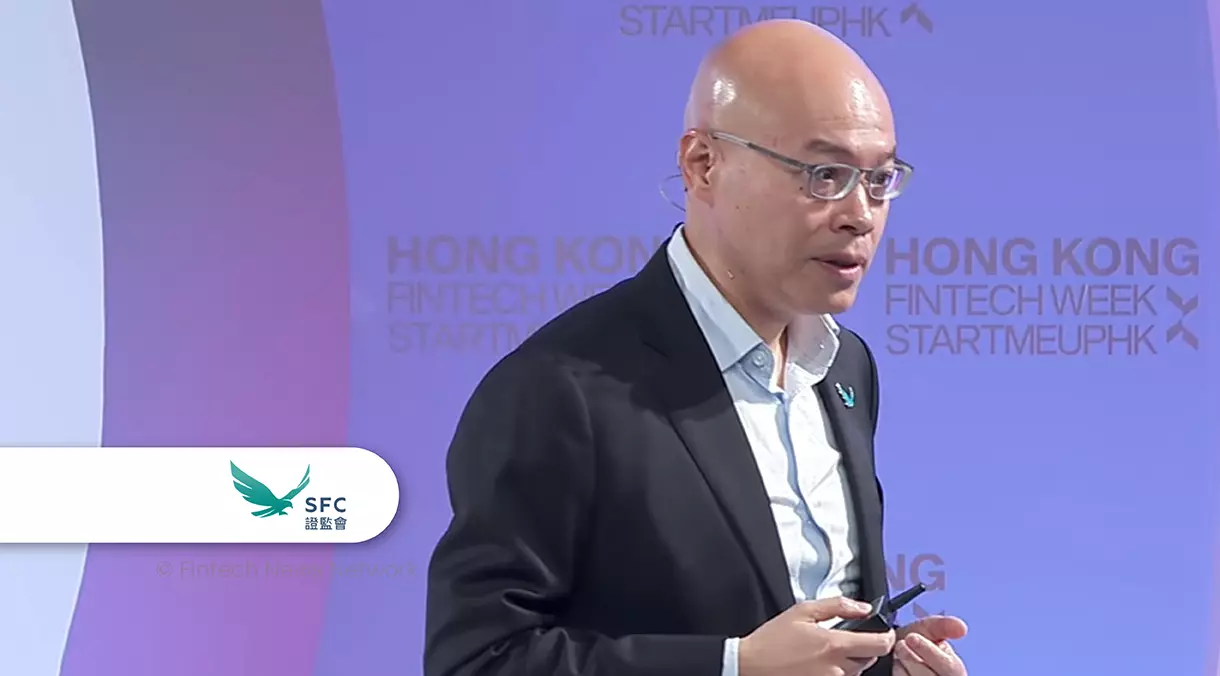
Eric shared,
Dr Eric Yip
“Our supervisory approach is safety-first, human-anchored and collaboration-led. As AI becomes more autonomous, we must put humans even more firmly in the driving seat. Scaling AI takes more than powerful models and promising use cases. It takes reliable infrastructure, sound data, the right expertise and governance that keeps pace with the technology.”
The SFC intends to focus on preserving human accountability throughout AI-enabled business processes. It plans to do this by setting clear objectives for organisations, defining limits and permitted actions, and ensuring that activity can be monitored and stopped when needed.
The regulator’s approach also centres on four areas: investor protection, cybersecurity and resilience, AI governance and applications, and engagement and collaboration with the industry, technology providers, academia, and other authorities.
Featured image edited by Fintech News Hong Kong based on an image by Hong Kong FinTech Week on YouTube