


In H1 2026, fintech deals in Asia-Pacific (APAC) declined, fueled by a reassessment of late-stage valuations, regulatory changes, and geopolitical concerns.

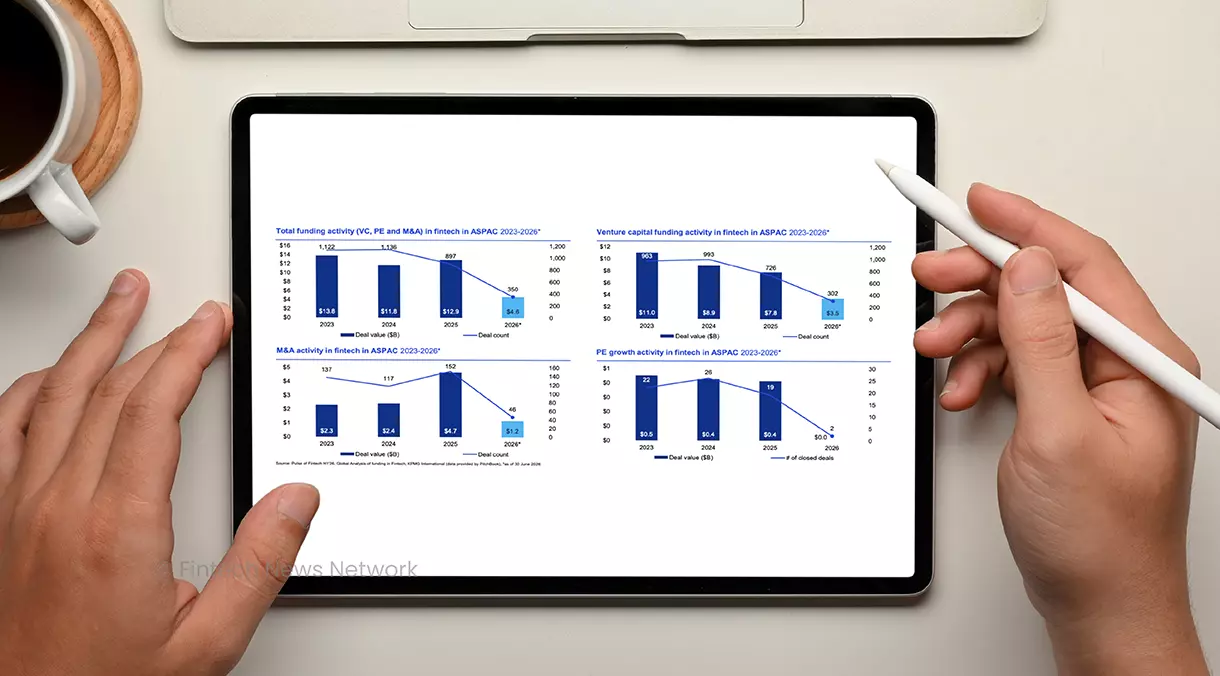
According to a new report by KPMG, fintech investments in the region stood at US$4.6 billion across 350 deals in H1 2026, down from US$7.1 billion across 426 deals in H2 2025.
VC deals drove much of this activity, accounting for many of the largest transactions in APAC. These transactions included a US$900 million raise by India-based rewards-focused credit management platform CRED, a US$320 million raise by Singapore-based payments company Airwallex, a US$280 million raise by India-based loan platform KreditBee, and a US$150 million raise by Australia-based crypto exchange Synthetix.

The KPMG report, released in August, also looks at the trends that drove fintech activity in APAC in H1 2026, emphasizing India’s continued dominance in fintech deal activity, Hong Kong’s sustained position as a fintech leader, particularly in the digital asset sector, and the growing corporate interest in regtech.
India leads APAC fintech investment
In H1 2026, India defined the downward investment trend, attracting US$2 billion across 101 deals. The figures represent an increase from US$1.8 billion and 102 deals in H2 205.
During this period, the country secured some of the region’s largest rounds, including CRED’s US$900 million Series H, KreditBee’s US$280 million Series E, and Juspay’s US$110 million Series D. These transactions constituted the first, fourth, and seventh largest fintech deals in the APAC region in H1 2026, respectively.
CRED is a rewarding fintech platform serving 17 million affluent customers. The platform enables members to manage credit cards and other payments, track and improve credit scores, and monitor financial activity across accounts. It rewards its members for every payment with curated access to shopping, travel, and premium experiences.
CRED plans to use the proceeds from its Series H to accelerate growth, build its institutional capabilities, and extend its leadership across categories.
KreditBee is a digital lending platform providing personal loans, business loans, loans against property, and two-wheeler loans along with credit report services and offerings based on India’s instant, real-time mobile payment system, the Unified Payments Interface (UPI). KreditBee serves over 18 million unique loan customers, and has disbursed more than 60 million loans across India, reporting assets under management (AUM) of US$1.5 billion as of March 2026.
KreditBee said it will use the proceeds from its Series E to expand its lending portfolio, deepen its presence across key markets, and strengthen its technology platform. It also plans to scale its artificial intelligence (AI) capabilities to improve risk assessment, enhance credit penetration, and deliver more personalized financial products.
Finally, Juspay is a payment infrastructure for enterprises and banks. It claims more than 500 global enterprises and lenders, processing over 300 million daily transactions for leading brands including Agoda, Amazon, Flipkart, Google, HSBC, IndiGo, Swiggy, Zepto, and Zurich Insurance, and exceeding an annualized total payment volume (TPV) of US$1 trillion.
Juspay plans to use its Series D to advance its AI capabilities, and expand its global footprint, with operations spanning APAC, Latin America (LatAm), Europe, the UK, the Middle East, and North America.
Following India, South Korea secured the second position in fintech investment activity in APAC. In H1 2026, the country secured US$899 million in fintech investments across 31 deals, with notable transactions including financial software company TwoDots’ US$740 million M&A transaction, the second largest fintech deal in the region during the period, and cryptocurrency exchange Korbit’s US$91.8 million corporate divestiture round. These transactions were the second and eighth largest fintech deals in APAC in H1 2026, respectively.
Hong Kong maintains position as a global fintech leader
In H1 2026, Hong Kong solidified its position as a global leader in fintech, particularly in the digital assets sector. This was largely driven by government support.
In February, the Hong Kong Monetary Authority (HKMA) released its Fintech Promotion Blueprint, setting out tactical measures and initiatives for advancing the use of fintech in the banking sector. The blueprint identifies five priority technology enablers and foundations for fintech, namely artificial intelligence (AI), distributed ledger technology (DLT), high-performance computing, data, and cyber resilience.
H1 2026 also saw several other supportive developments in regard to digital assets. In April, the HKMA issued its first two stablecoin issuer licenses to Anchorpoint Financial, a subsidiary of Standard Chartered Bank Hong Kong (SCBHK), and HSBC, further legitimizing the industry.
Anchorpoint Financial, a joint venture between SCBHK, Hong Kong Telecommunications (HKT), and Animoca Brands, issues a Hong Kong dollar (HKD)-backed digital currency called HKDAP. HKDAP is built on public blockchains with native bank-grade compliance and risk management standards. Anchorpoint Financial started a limited rollout of the stablecoin in August 2026, focusing on institutional payments and settlement before adding more access channels and cross-border applications, CoinDesk reported.
HSBC, meanwhile, plans to launch its HKD-denominated stablecoin in the second half of 2026. This stablecoin will be integrated into two of the bank’s most widely used digital platforms: the PayMe mobile payment and digital wallet app, and the HSBC HK Mobile Banking App (HSBC HK App), a digital banking app. The stablecoin will initially be applied to use cases, including peer-to-peer payments, peer-to-merchant payments, and tokenized investments.
On August 2025, Hong Kong’s Stablecoins Ordinance came into effect, establishing a licensing regime overseen by the HKMA for issuers of fiat-referenced stablecoins. This ordinance creates a regulated framework for institutional stablecoin issuance and payments infrastructure in Hong Kong, mandating issuers to meet requirements around reserve assets, redemption, risk management, governance, disclosure and anti-money laundering (AML) and countering the financing of terrorism (CFT) controls.
Corporates show interest in regtech
In H1 2026, traditional corporates and mature fintech startups around the world continued to show appetite for regtech and compliance related technologies, particularly related to AML and know-your-customer (KYC). However, investment in the space in APAC was masked because many prominent regtech players are based in Europe and North America.
One notable transaction in APAC, however, was IDfy’s US$52 million Series F in February. IDfy offers a range of KYC, know-your-business (KYB), onboarding risk management and privacy solutions. The startup is said to complete 2 million daily verifications across its 500-strong client base, Fintech Futures reported. It said it will use the proceeds to accelerate its global expansion, invest in strategic acquisitions, and deepen innovation across its trust and privacy stack.
KPMG also highlights other fintech investment trends in the APAC region. Notably, fintech investment in China declined, totaling just US$149 million invested across 33 deals in H1 2026. According to KPMG, part of this softness can be attributed to the structure of China’s fintech sector, including its mature payments, consumer finance, and digital lending spaces. Many fintech capabilities are now internalized by banks, insurers and large platforms, leading many interactions with fintech startups to occur through ecosystem partnerships, joint research and development (R&D) and other initiatives, rather than conventional VC, PE and M&A.
Another trend observed by KPMG is the more cautious and cost-focused approach by investors, especially in Australia. This trend is influenced by the Reserve Bank of Australia’s decision to raise interest rates three times in H1 2026. Furthermore, the federal government announced capital gains tax changes as part of its 2026-2027 budget in June, tightening funding from tax-sensitive investors.
Featured image: Edited by Fintech News Singapore, based on image by thanyakij-12 via Magnific
