


“Hong Kong is made for collaboration. Built for innovation, for companies, entrepreneurs, investors and professionals.”
Those were the opening words of John KC Lee, Chief Executive of the Hong Kong Special Administrative Region, as he officially kicked off Day 1 of the Hong Kong Fintech Week 2025.
The event opened with record-breaking energy, marking its 10th anniversary with the largest fintech gathering in the city’s history. It drew over 37,000 participants, 800 speakers, and 700 exhibitors from more than 100 economies, said John Lee, underscoring Hong Kong’s position as Asia’s fintech powerhouse and global connector.
Across the keynotes and forums, Day 1 set a definitive tone for the week ahead in Hong Kong Fintech Week 2025. It brought together policymakers, bankers, investors, and technologists to explore Hong Kong’s next chapter in finance.
Discussions ranged from the rise of AI, stablecoins, and biotech as the next trillion-dollar opportunities to the HKMA’s Fintech 2030 vision, centred on data, artificial intelligence, resilience, and tokenisation.
Here are five key highlights that capture the essence of the city’s evolving fintech story.
Charting the Next Fintech Chapter
A panel featuring Christopher Hui, Secretary for Financial Services and the Treasury of the Government of the Hong Kong SAR; Eric Xiandong Jing, Chairman of Ant Group; and Fred Hu, Founder, Chairman, and CEO of Primavera Capital Group, moderated by Drew Propson, Head, Technology and Innovation in Financial Services at the World Economic Forum, explored emerging technologies in Hong Kong’s financial landscape.
During the session titled Curating the New Fintech Era, Christopher Hui identified blockchain and artificial intelligence as the most transformative technologies for Hong Kong’s financial sector. Citing HKMA data, he said about 75% of local financial institutions have already adopted or piloted generative AI, with that figure expected to surpass 87% within three to five years.
He also emphasised the importance of regulatory sandboxes and subsidy programmes in driving innovation and refining policy and regulatory frameworks.
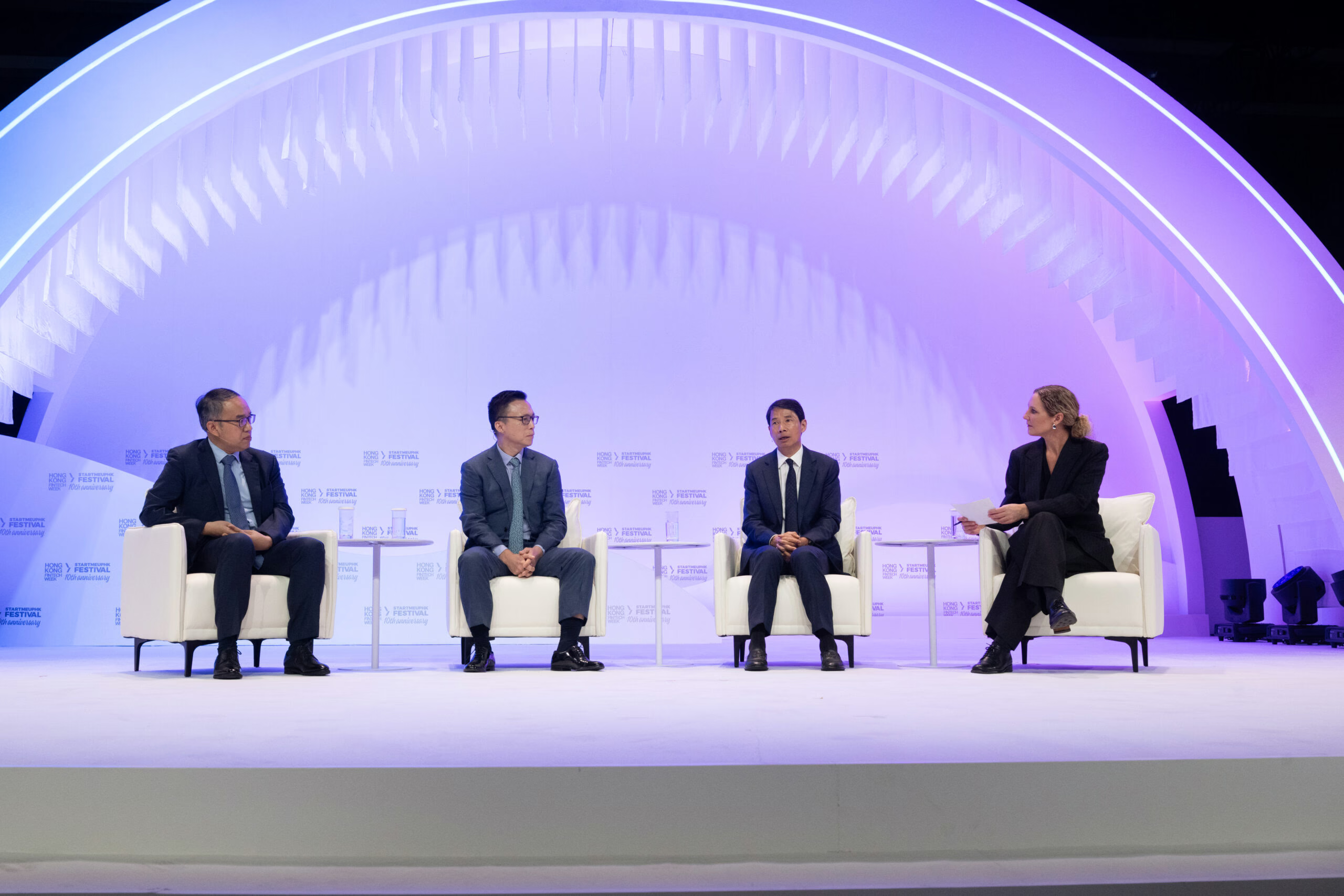
Meanwhile, Eric Jing predicted a rapid adoption of genAI across financial services, from AI-powered customer-facing account managers to tokenisation for real-time global settlements. He emphasised Hong Kong’s position as an international financial hub that enables Chinese companies to expand globally, urging continued efforts to build on that advantage.
Fred Hu highlighted three areas to watch: automation in wealth management, the growth of green finance, and improvements in cross-border transaction efficiency and security. He called the Hong Kong government to prioritise cross-border data connectivity, as this would reduce data fragmentation. He also expressed his optimism about deeper data-sharing between Hong Kong and the Chinese Mainland.
FinTech 2030 Sets the Stage for Hong Kong’s Fintech 3.0 Era
“Our forthcoming AI Strategy will unite banks, tech innovators, and academia to embed AI deeply into the sector’s infrastructure, in a way that is safe, scalable and future-proof.”
That was the message from Eddie Yue, Chief Executive of the Hong Kong Monetary Authority (HKMA), during his keynote address, as he unveiled the four strategic pillars of HKMA’s Fintech 2030 vision: data, AI, resilience, and tokenisation. Together, these pillars are designed to reinforce Hong Kong’s position as a resilient, future-ready global financial hub.
Reflecting on the city’s fintech journey over the past decade, Eddie Yue described the next chapter as Hong Kong’s “Fintech 3.0 Era”, one where technology is seamlessly embedded in daily life, underpinned by trust, transparency, and intelligence.

On AI, Eddie Yue noted that the technology has moved from experimental to essential, with over three-quarters of Hong Kong’s banks already deploying AI solutions. He called for greater industry collaboration to co-create a shared AI infrastructure, as this would enable smaller and mid-sized banks to access and benefit from the technology, too.
He also reaffirmed tokenisation as a top priority, calling it a key enabler for cross-border investments and frictionless financial infrastructure. Finally, he highlighted resilience as more than just the ability to withstand shocks. It is also the capability to stay secure, adaptive, and forward-looking through every new wave of innovation.
Watch the keynote replay here.
Hong Kong’s Role in the Future of International Financial Centres
In the segment on Sustaining Excellence: Hong Kong’s Role in the Future of International Financial Centre, Paul Chan, Financial Secretary of the Government of the Hong Kong SAR, outlined Hong Kong’s strategic vision for financial innovation, underscoring the role of regulators as enablers.
He highlighted initiatives such as Project Ensemble, the tokenisation of green bonds, and the government’s AI+ strategy, all aimed at ensuring Hong Kong’s financial system remains sustainable, secure, and globally competitive. He shared,
“In the financial sector, we firmly believe that digitalisation is a transformative force that must be embraced. It enhances efficiency, reduces costs, enables more personalised services, and plays a critical role in promoting financial inclusion.”
The session brought together some of the most influential voices shaping global finance. Aside from Paul Chan, it also featured Georges Elhedery, Group Chief Executive of HSBC, and Bill Winters, Group Chief Executive of Standard Chartered. Alpha Lau, Director-General of Investment Promotion at Invest Hong Kong, moderated the discussion.

The discussion, one of many in Hong Kong Fintech Week 2025, explored Hong Kong’s role as both a bridge linking global institutions with the Chinese Mainland and a launchpad for Mainland enterprises going global.
Panellists agreed that Hong Kong is on track to surpass Switzerland as the world’s leading cross-border wealth management hub, supported by its robust financial ecosystem, live adoption of tokenised assets and blockchain settlements, and the expansion of “Connect” schemes into the Middle East and Southeast Asia.
AI, Stablecoins and Biotech Supercharge the Next $1 Trillion Asset Class
In the session titled Tech Megatrends and the Next $1 Trillion Asset Class, Duane Kuang, Founding Managing Partner at Qiming Venture Partners, and John Lindfors, Co-founder and Managing Partner at DST Global, explored the technologies shaping the next transformative wave in technology and investment.
The discussion was moderated by Emily Tan, Anchor and Senior Correspondent at CNBC International.

The panellists identified AI as the most transformative megatrend, pointing to Nvidia’s $5 trillion market capitalisation as a symbol of the sector’s exponential growth.
While valuations may appear overheated in the short term, both experts agreed that AI is far from an industry-wide bubble, particularly in China, where AI remains relatively underdeveloped compared to the United States. Both Kuang and Lindfors also emphasised that the strength of evaluating teams and market potential mattered more than traditional financial metrics for early-stage AI firms.
The conversation also turned to stablecoins, now adopted and regulated in 11 key jurisdictions, including Hong Kong, Japan, Singapore, the UK, the US, and the UAE and catalysing innovation in cross-border payment systems.
Reimagining Personal Banking With Technology, Trust and Self-Sufficiency
In the segment on Personal Banking in the Platform Era: Trust, Technology, and Cross-Border Access, leading figures from regional and international banks shared how AI, digitalisation, and cross-border integration are reshaping the personal banking landscape.
The discussion underscored how trust, data, and technology now define the next phase of competition and growth for financial institutions.
Arnold Chow, General Manager of the Personal Banking Product Department at Bank of China (Hong Kong), highlighted the bank’s digital transformation journey over the past five years, which has lifted efficiency by 8% and grown market share to 30% in select product segments.
He noted that AI is now embedded across wealth and risk protection as well as for training for frontline staff, with upcoming plans to deepen digital partnerships within and beyond the Greater Bay Area.
Alfian Sharifuddin, Managing Director and Head of Technology and Operations for Hong Kong and Mainland China at DBS Bank Hong Kong, spoke on the importance of trust in AI. To mitigate the risks of AI hallucinations, DBS has implemented a Retrieval-Augmented Generation (RAG) framework that enables its Large Language Model to operate in a controlled environment.

Colin Cui, Vice President and Head of Regional Finance Business at Huawei Asia Pacific, detailed how the company’s continuous reinvestment of roughly 20% of its annual revenue into R&D enables Huawei to self-design and manufacture competitive solutions. This ensures a rapid response to market trends and customer needs.
Huiya Yao, Head of Fintech Innovation at WeBank, emphasised that AI adoption requires a mindset shift across all banks, including mid-tier enterprises. WeBank’s internal AI training and certification programme equips teams with AI literacy, complemented by a delivery model that empowers its business departments to develop their own AI applications.
Moderated by King Leung, Global Head of Financial Services, Fintech and Sustainability at Invest Hong Kong, the discussion concluded with his observations. He shared that China continues to lead in advanced technology adoption, while Hong Kong’s position as a fintech hub drives competition, innovation and its crucial role within the Greater Bay Area.
Follow the latest updates on the Hong Kong Fintech Week 2025 from Fintech News Hong Kong.
Featured image by Invest Hong Kong
