



Digital assets have been swiftly shifting into the architecture of finance. Banks, payment firms, and market players are accelerating their digital asset strategies in tandem, in an attempt to keep up with client demand.
However, as more value moves on-chain, the higher the dependency on the private key that controls it. It is the same root problem organisations face in traditional finance, where they deal with trusting the institution:
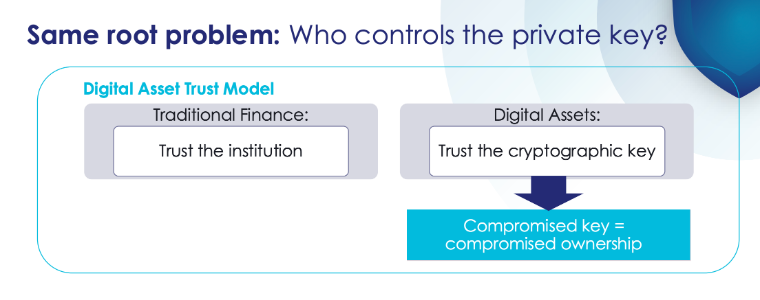
In traditional finance, customers place their trust in the institution. In digital assets, cryptographic keys are also a critical foundation of trust, as control of a key can enable transactions involving the associated assets.
Crypto-related hacks are growing both in frequency and scale. Research from Chainalysis shares that 43.8% of digital asset losses, in particular, came from private-key compromise, making key security the single and biggest point of failure.
What are the key challenges that hinder digital asset security, and how can you navigate them?
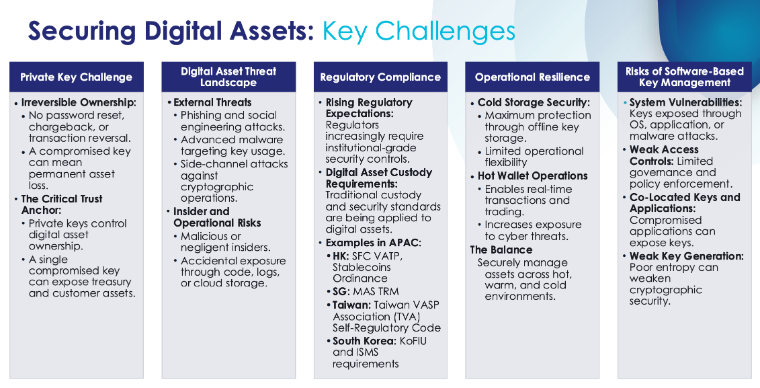
5 Key Challenges in Securing Digital Assets
1. One Compromised Key Can Put an Institution’s Assets at Risk
In digital assets, control of a private key can enable transactions involving associated assets. Where people trust the institution in traditional finance, that trust now rests on a cryptographic key. The guide from Thales refers to the key as “the critical trust anchor.”
It is indeed critical, as many blockchain transactions cannot be unilaterally reversed, and conventional password resets or chargebacks generally do not apply.
If a key is compromised, the asset it controls can be lost for good. For an institution, one leaked key can expose the holdings it controls, depending on wallet segregation and signing controls.
2. The Threat to Digital Assets Can Come From Within
Attacks on the digital asset landscape occur from both outside and inside. Outside, attackers use phishing and social engineering to trick staff into giving up access.
They also use advanced malware built to target how keys are used, and side-channel attacks that try to pull secrets out of the cryptographic operations themselves.
Inside, the risk can be a malicious insider, or simply carelessness, such as a key accidentally exposed in code, system logs or cloud storage.
3. Digital Asset Custody Faces a Higher Regulatory Bar
As digital assets move into mainstream finance, regulators increasingly expect the same institutional-grade security controls, with custody and security standards now being applied to digital assets.
Across Asia Pacific, the guide points to regulatory requirements that vary from Singapore’s Technology Risk Management (TRM) guidelines by the Monetary Authority of Singapore (MAS) to the Stablecoins Ordinance in Hong Kong.
4. Keeping Assets Safe Without Slowing the Business
Institutions have to balance security against speed. Cold storage keeps keys offline, reducing exposure to online attacks, but that can make it slower to move assets. Hot wallets stay connected so that transactions and trading can happen in real time, but that connection gives attackers a way in.
Neither works on its own for an exchange or custodian serving active clients. The real task is managing assets across hot, warm, and cold setups, so that only what’s needed for daily operations is online and the rest stays locked away.
5. When an Application Breach Becomes a Key Breach
Many platforms still store and manage keys in software, which brings its own weaknesses. Keys held in software can be exposed through flaws in the operating system or applications, or stolen by malware. Access controls are often weak, with limited governance and policy enforcement.
When keys sit on the same systems as the applications that use them, breaching the application can also expose the keys. Even creating keys can go wrong: if the randomness used to generate them is poor, the keys are weaker than they look.
HSMs, a Hardware-Backed Root of Trust for Two Financial Worlds
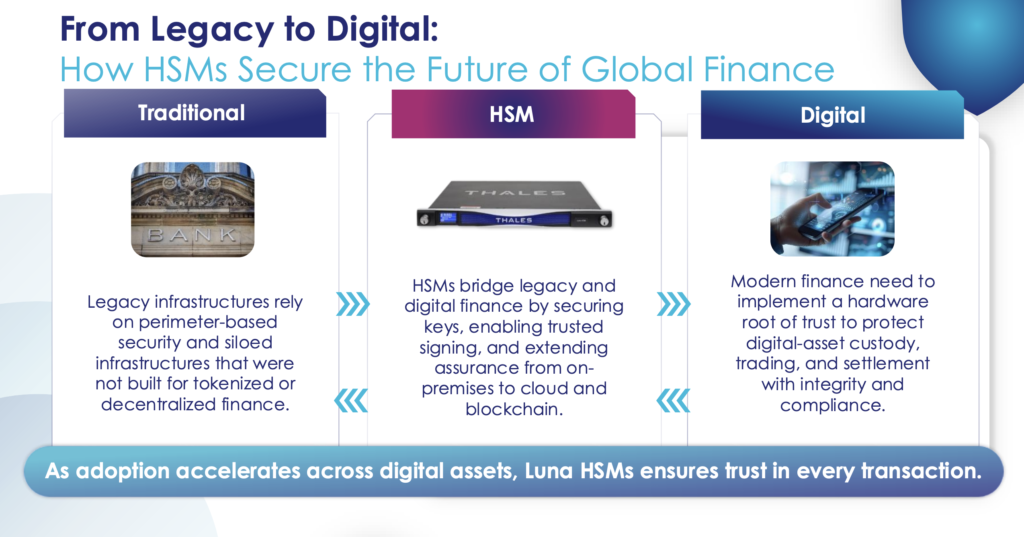
A hardware security module (HSM) is a dedicated cryptographic processor that creates, stores, and uses the digital keys that keep data and transactions secure. The keys are protected within hardened, tamper-resistant hardware, which makes them much harder to extract. Preventing unauthorised signing also requires appropriate access controls and approval workflows.
HSMs have long protected critical systems at banks and payment networks, and their role is growing. They now function as the bridge between legacy and digital finance, where HSMs secure keys, enable trusted signing, and extend assurance from on-premises systems to the cloud and blockchain.
As digital services expand across cloud, hybrid, and other complex environments, organisations need trusted cryptographic infrastructure for public key infrastructure (PKI), payment security, code signing, key protection and post-quantum readiness.
HSMs, available as physical appliances or cloud services, provide a critical foundation for it.
They work best as one layer in a defence-in-depth approach that combines secure key generation and storage, controlled signing access, approval workflows, segregation of duties, monitoring. and recovery.
Thales’ Luna HSMs are designed to give institutions strong protection and control over over their private keys, supporting security across applications, digital transactions, and identities. Keys are protected within FIPS 140-3 Level 3 and Common Criteria-certified hardware.
When integrated with appropriate custody platforms and approval workflows, Luna HSMs can support controlled signing across hot, warm, and cold environments. Hardware-backed key protection also supports institutions’ efforts to meet applicable regulatory and security requirements, alongside broader governance and operational controls.
Luna HSMs support post-quantum migration and crypto-agility through capabilities available in supported products and releases, including the NIST-standardised algorithms ML-KEM and ML-DSA. Migration also requires assessing the applications, protocols and networks that use these capabilities.
The result is a solution that helps institutions strengthen and support their compliance as security threats grow, regulations shift, and digital demands evolve.
Download the Executive Guide to Securing Digital Assets: Elevate Digital Asset Security with HSMs guidebook to learn how Luna HSMs enable trust across the digital asset custody market.
Featured image edited by Fintech News Singapore based on an image by rawpixel.com on Magnific
