



Close Menu
    • Digital Transformation
    • Open Banking
    • Funding
    • Remittance
    • Regtech
    • Hong Kong Fintech Report
    • HK Fintech Startup Listing
    • China
    • Taiwan
    • Submit Press Release
    Facebook LinkedIn X (Twitter) YouTube RSS
    • About
      • About Fintech News Network
      • Contact Us
      • Work With Us
    • FNN Media Kit
    • Fintech Newsletter
    • Submit Press Release
    • Submit
      • Submit Press Release
      • Submit Startup
      • Webinar Inquiry APAC
    • HK Fintech Startup Directory
    Fintech Hong Kong
    part of Fintech News Network

    Fintech News Network

    LinkedIn Facebook X (Twitter) Instagram YouTube TikTok RSS
    Free Newsletter
    • Payments
    • Blockchain
    • Wealthtech
    • Virtual Banking
    • InsurTech
    • Lending
    • Report
    • Fintech Events
    Fintech Hong Kong

    Fintech News Network

    Home»Lending»4 Reasons Banks Keep Losing E-Commerce Merchant Financing to Fintechs
    Lending

    4 Reasons Banks Keep Losing E-Commerce Merchant Financing to Fintechs

    A US$1.2 trillion APAC credit gap separates banks from online sellers, according to Quinlan & Associates, which maps three routes back into the market.
    Annette RowenaAnnette RowenaJuly 14, 20265 Mins Read
    LinkedIn Facebook Twitter Telegram Copy Link Email
    e-commerce merchant financing
    Share
    LinkedIn Facebook Twitter Telegram Copy Link Email
    Free Newsletter

    Get the hottest Fintech Hong Kong News once a month in your Inbox

    For decades, getting a bank loan has meant the same process of submitting financial statements, proving collateral where required, and waiting on the bank’s decision. That model has served traditional retail well. However, it doesn’t really hold up well in e-commerce merchant financing, especially given the breadth at stake: e-commerce platforms have generated US$13.2 trillion in B2B and B2C gross merchandise value (GMV) in 2025.

    Given the sheer scale and the rich, contextualised data these platforms can generate, the logical move for banks would have been to plug in and enhance their underwriting potential.

    Yet, in a unique turn, traditional institutions and banks have done the opposite. Held back by operational friction and prohibitive onboarding costs, banks have stayed disconnected from the e-commerce ecosystem.

    This has inadvertently opened up an APAC e-commerce credit gap of US$1.2 trillion in 2025, according to a recent report by Quinlan and Associates, Banking on E-Commerce.

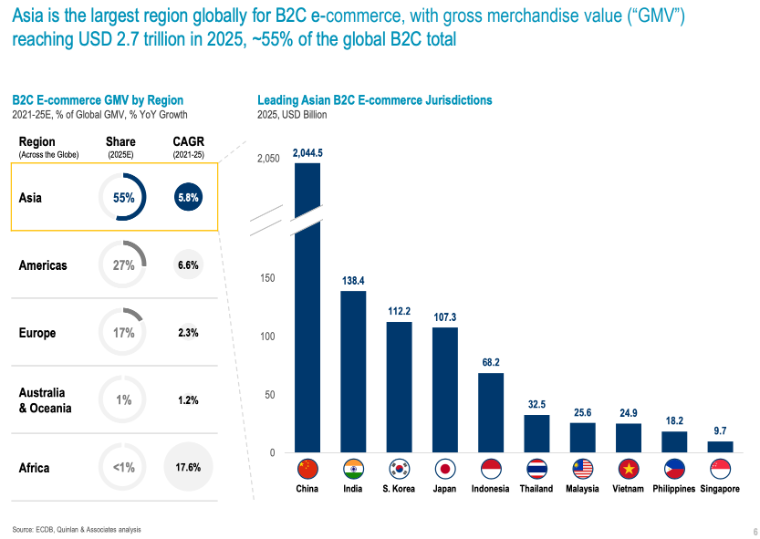
    Most of that opportunity lies in Asia, which drives 55% of global B2C e-commerce Gross Merchandise Value, more than double the share of the Americas.
    Asia key driver e-commerce
    Source: Quinlan and Associates

    Within Asia itself, China alone represents 42% of global B2C e-commerce Gross Merchandise Value. Over the past decade, a wave of fintech lenders has emerged to swoop in and capitalise on this opportunity.

    Still, the report finds that the door remains open for incumbents to take a more direct role in e-commerce merchant financing, whether through co-lending arrangements or lending to merchants outright.

    4 Barriers Blocking Bank Financing for E-Commerce Merchants

    The report indicates that banks lack access to real-time financial and operational data, which results in inaccurate credit profiling, incompatible product offerings, and the inability to control platform funds.

    1. Banks Can’t See Real-Time Merchant Data

    Banks have long leaned on historical financial and business data when extending SME loans. This is a method that leaves them without the data models to read more predictive, real-time signals like revenue trends and order velocity.

    inaccurate credit profiling traditional banks
    Source: Quinlan and Associates

    As a result, e-commerce merchants often get lumped into broader retail or SME risk pools, where their credit risk can end up overstated.  Alternative lenders, working with richer data, have shown what banks are missing: reductions of up to 80% in 90-day non-performing loan ratios.

    The barrier runs deeper than risk models. Many e-commerce SMEs carry financial records that are under-documented, insufficient, or unaudited. Due to this, a bank may render them ineligible for financing.

    Also, many SMEs take up to two years to break even, making the kind of financial track record banks require a luxury few can afford. According to the Quinlan & Associates report, a small percentage of 23% of ASEAN SME merchants have received support from traditional banks.

    2. Bank Loan Products Don’t Match E-Commerce Cash Flows

    Even when e-commerce merchants clear the credit hurdle, the products waiting for them don’t fit. Traditional SME loans are built around stable, linear cash flows, while e-commerce revenues are highly cyclical and event-driven.

    peak month e-commerce merchant cycles in china
    Source: Quinlan and Associates

    That structural gap makes the products hard to use as intended. For example, consider the scale of the swings. Peak-month sales in China’s e-commerce market run 68% higher than the annual average, while blockbuster campaign days on Shopee and Lazada drive daily sales to 14x and 10x their norms.

    3. Merchant Funds Sit on Platforms, Beyond Banks’ Reach

    A further barrier lies in where the money actually sits. Merchant funds are held on the platforms, not with the banks. This leaves lenders with limited visibility and even less enforceability over the cash meant to repay them.

    The risks cut both ways. On one side, platform actions like account suspensions or fund freezes can abruptly choke a merchant’s cash flow and, with it, their capacity to repay. On the other hand, merchants themselves may spend those platform balances well before their repayment obligations fall due.

    4. Manual KYC Makes Small Merchants Costly to Serve

    Perhaps the biggest barrier of all is the sheer cost of getting a merchant through the door. Onboarding an MSME weighs banks down with manual processes, costly third-party services, legacy system integrations, and the ongoing compliance burden of cross-border activity.

    msme kyc cost for loans
    Source: Quinlan and Associates

    For example, the manual load of missing documentation, secondary reviews, and mapping a corporate hierarchy to trace ultimate beneficial owners all still demand human attention.

    Due to this, banks can take up to two years before they break even on the KYC costs of a MSME client.

    3 Ways Banks Can Explore E-Commerce Lending

    For banks eyeing the e-commerce boom, the question is how close to the merchant they’re willing to get. The report maps out three routes, each a step deeper into the market than the last.

    ecommerce lending avenues for banks
    Source: Quinlan and Associates

    1. Warehouse Financing, Where Banks Fund Fintechs

    The most cautious is warehouse financing: extending a wholesale facility to a fintech that specialises in e-commerce merchant lending. The fintech does the lending while the bank supplies the capital. The bank’s participation involves minimal operational involvement.

    2. Co-Lending Agreements, Where Risk and Yield are Shared

    One step closer is co-lending, where a bank partners with a specialist fintech to jointly fund loans. Risk and yield are shared.

    3. Direct Lending, Where Banks Own the Merchant Relationship

    The last option is the direct route, in which banks lend directly to e-commerce merchants.

    So far, most major banks have chosen the first door, content to participate indirectly through warehouse financing.

    The report indicates that the real prize lies behind the other two, as co-lending and direct lending offer greater yield and the borrower relationship itself. The question for banks, then, is whether the safety of the sidelines is still worth it.

    Featured image edited by Fintech News Hong Kong, based on an image by user6285028 on Magnific

    Quinlan & Associates
    Share. LinkedIn Facebook Twitter Telegram Copy Link Email

    Author

    Annette Rowena

    Annette is a Senior Writer for Fintech News Network.

    Related Posts

    Hong Kong Consumer Credit Market Sees Rising Gen Z Share in Card Originations

    June 16, 2026

    Hong Kong SME Credit Market Remains Stable in Early 2026

    May 5, 2026

    HKMA Expands SME Support With HK$450B Fund and Faster Loan Approvals

    April 30, 2026

    Hang Seng Rolls Out 10-Second Digital SME Loan Approvals in Hong Kong

    April 22, 2026

    TransUnion Urges Lenders to Rethink Credit Risk for Gig Workers in Hong Kong

    April 16, 2026

    Mox Bank Acquires US$1 Billion Personal Loan Portfolio from Standard Chartered

    March 24, 2026

    SBI VC Trade Launches USDC Lending Service for Retail Investors in Japan

    March 19, 2026

    MSIG Joins US$6B IFC Credit Insurance Facility to Boost Emerging Market Lending

    February 25, 2026
    Security

    From Key Protection to Operational Governance: HSMs in Digital Assets

    23 July 2026
    Fintech Hong Kong Newsletter
    Subscribe to the most important Fintech Hong Kong News
    Follow Us
    • LinkedIn
    • Facebook
    • X / Twitter
    • Instagram
    • YouTube
    • TikTok
    Featured Fintech Webinar

    Entrust Webinar

    Featured Fintech Reports

    Featured Fintech Programme

    Global FastTrack

    Featured Fintech Event

    Hong Kong FinTech Week and StartmeupHK

    Featured Webinar Replay

    Temenos webinar

    Featured Fintech Videos

    TNG Digital

    Fime

    Hong Kong Fintech Report

    Hong Kong Fintech Report 2025

    Philippines Fintech Report

    Malaysia Fintech Report

    MY Fintech Report 2025

    Singapore Fintech Report

    SG Fintech Map 2025

    Indonesia Fintech Report

    Indonesia Fintech Report 2025

    UAE Fintech Report

    UAE Fintech Map 2024

    Whitepapers & E-Books
    State of Digital Trust: AI Governance Benchmark
    State of Digital Trust: AI Governance Benchmark
    Sumsub
    Upcoming Fintech Events
    When Account Takeover Moves Past Onboarding
    August 19, 2026
    Featured Online
    Bitcoin Hong Kong 2026
    August 27, 2026
    -
    August 28, 2026
    Hong Kong
    Building the Future of Borderless Payments
    September 2, 2026
    Featured Online
    2026 Green Fintech Symposium
    September 11, 2026
    Hong Kong
    -
    Central
    Taiwan Innotech Expo 2026
    September 17, 2026
    -
    September 19, 2026
    Taiwan
    -
    Taipei
    Promote Event View More
    FINTECH RESOURCES

    Navigations
    • About Fintech News Network
    • Contact Us
    • Media Kit
    • Work With Us
    • Fintech Hong Kong Newsletter
    • Submit a Fintech Hong Kong Press Release
    • Fintech Events Hong Kong & China
    • Fintech HK Startup Report
    • Submit Your HK Fintech Startup
    • Privacy Policy / Disclaimer
    Other Fintech News Network Publications
    Fintech News Hong Kong
    Fintech News Singapore
    Fintech News Malaysia
    Fintech News Philippines
    Fintech News Network Indonesia
    Fintech News Network Australia
    Fintech News Switzerland
    Fintech News Baltic
    Fintech News Nordics
    Fintech News America
    Fintech News Middle East
    Fintech News Africa
    Get Informed

    Subscribe to Updates

    Subscribe to the most important Fintech Hong Kong News

    LinkedIn Facebook X (Twitter) YouTube RSS
    • About Fintech News Network
    • Contact Us
    • Media Kit
    • Work With Us
    • Fintech Hong Kong Newsletter
    • Submit a Fintech Hong Kong Press Release
    • Fintech Events Hong Kong & China
    • Fintech HK Startup Report
    • Submit Your HK Fintech Startup
    • Privacy Policy / Disclaimer
    © 2015 - 2026 Copyright Finanzpro GmbH. All Rights reserved.

    Type above and press Enter to search. Press Esc to cancel.