



China’s artificial intelligence (AI) stakeholders, including large-scale cloud service providers, technology giants, and telecommunication firms, are expected to more than double their annual capital expenditure (capex) on AI infrastructure this year, with ByteDance, Alibaba and Tencent leading the charge, according to a new report by independent research provider Rhodium Group.

These firms are projected to spend CNY 932 billion (US$139 billion) on AI infrastructure in 2026, based on desk research and a survey of 13 listed companies, representing a 103% rise from the 2025 figure of CNY 460 billion (US$68 billion). ByteDance will be the largest contributor to China’s AI spending this year, providing about 50% of the total, followed by Tencent and Baidu.
By 2027, China’s hyperscalers and telecoms are forecast to spend CNY 1.2 trillion (US$193 billion), growing 39% from this year’s estimate.

Financing AI investments
Chinese hyperscalers and other participants in the AI frenzy are financing their investments through various means, the research found.
Hyperscalers, namely Alibaba, Tencent, and Baidu, mostly rely on borrowing via loans and bonds, and are also raising cash by selling existing short-term investment assets. In their financing mix, equity is also gaining weight, with many cutting stock buybacks to preserve capital for AI.
Huawei and telecom firms depend almost entirely on operating cash flows, reflecting their oligopoly positions within China’s economy. Telecom giants carry minimal debt, while Huawei still has a large balance of long-term bank loans. At the same time, these players spend less than the hyperscalers.
Frontier AI labs have negative operating cash flows, remaining in early stages of business operations and spending heavily on research and development (R&D). These labs depend heavily on equity issuance, and marginally on loans.
In H1 2026, private equity and venture capital (PE/VC) investments, initial public offering (IPO) inflows, and private placement into frontier AI labs Zhipu AI, MiniMax, DeepSeek, and Moonshot soared to CNY 179 billion (US$26.7 billion), marking a staggering increase from CNY 9 billion (US$1.3 billion) for the whole year 2025.

Independent data center operators have the most diversified sources of financing. These players rely on four equally important channels, comprising operating cash flow, loans and bonds, equity issuance, and asset-backed securities (ABS), real-estate investment trusts (REITs), and financial leases.
Unlike hyperscalers and telecoms, these operators do not have a cash-generating business to help alleviate the capex burdens of AI spending, nor do they attract much in equity financing. Consequently, they tend to use ABS, REITs and financial leases to a greater extent.
Monetization remains limited
Operating cashflows generated from China’s AI firms in cloud, data centers, and AI operations cannot yet sustain their capex for the sector, with both revenue and profitability remaining low compared to other business lines, and to their US peers.
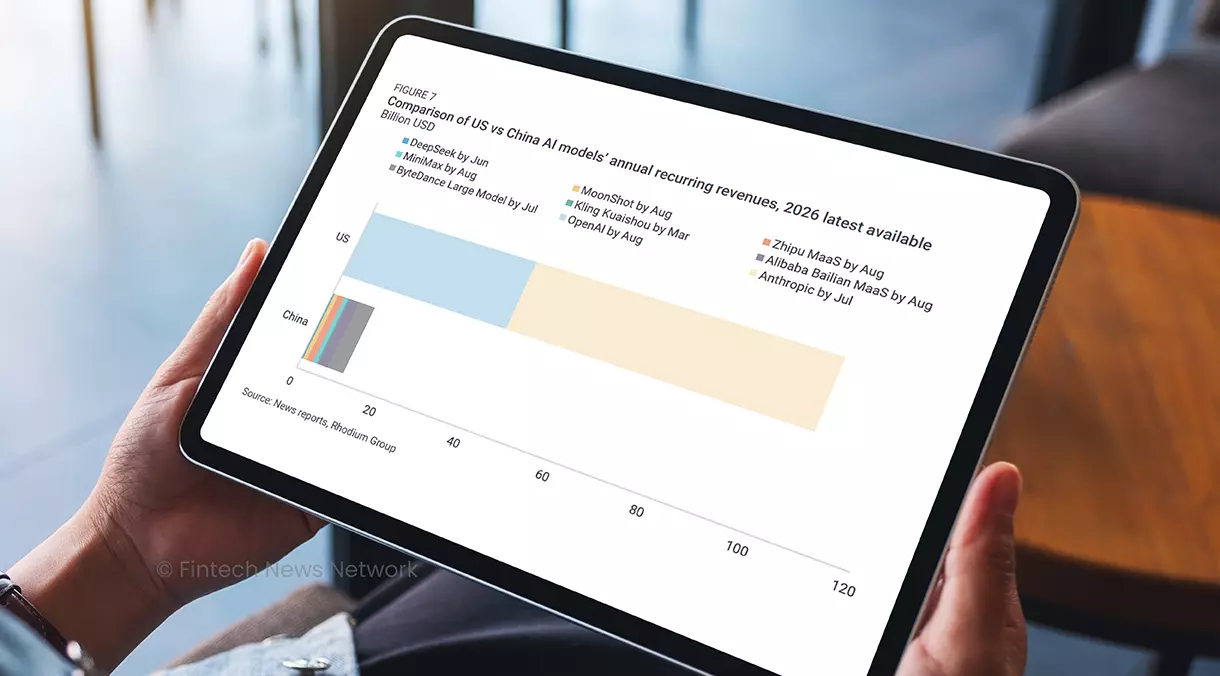
Total annual recurring revenues (ARR) for all of China’s AI models currently stand at just US$10.7 billion based on the latest available data, representing around 10% of the latest reported levels for OpenAI and Anthropic at this point.

Chinese AI firms also face greater financial pressures than their US peers, despite improving economics at the API level. This gap stems from structurally lower pricing power in China, driven by customers less willing to pay, intense competition, and the widespread availability of open-weight models.
Rising infrastructure and compute costs add further pressure, while efforts to shift toward higher-margin enterprise-focused and API services require additional investment and often result in near-term margin tradeoffs.
Despite year-over-year (YoY) growth in China’s AI capital spending, the scale of its AI buildout still represents only about 20% of the level of US investment. In comparison to AI capex projected to reach US$139 billion in 2026, AI spending in the US is set to total US$581 billion the US this year, according to Goldman Sachs Research.

AI spending forecasts
By 2031, annual spending on AI infrastructure is expected to reach US$1.5 trillion, according to Bain and Company. This cost will cover expenses on new data center infrastructure and compute capacity as well as ongoing upgrades to the installed base of GPUs, memory, and networking equipment.
By then, AI’s high demand for computing power will require US$6 trillion in annual revenue, and much of this value will need to come from new innovations beyond employee productivity.
Existing consumer AI products, through subscriptions and advertising, are projected to generate an estimated US$200 billion to US$400 billion by 2031, while enterprise adoption could contribute another US$1 trillion to US$1.4 trillion in gains to providers. Together, these two markets could total between US$1.2-1.8 trillion.
This leaves a US$4.2 trillion gap that would have to be filled by new AI-driven markets, such as autonomous vehicles and industrial systems, robotics and physical AI, search and advertising, and new offerings including AI-driven drug discovery, always-available mental health support, materials science breakthroughs, and autonomous scientific research.

Featured image: Edited by Fintech News Hong Kong, based on image by sweetmaroonstudio via Magnific
